OPTIMISING EMISSION RULES AND PROFITABILITY
In spring 2026, Auramarine brings you a focused four-part webinar series on the future of marine fuels and emissions compliance in 2026 and beyond. Before the webinar, we will share expert articles on each topic to learn more before the webinar. Read more about optimising emission rules and profitability.
The shipping industry is entering an era of rapid change, where regulatory frameworks are both diversifying and tightening. The interplay between the EU’s regulatory environment and the International Maritime Organization (IMO) will significantly shape operational, financial, and strategic decisions for shipping companies over the next two decades. This article summarizes the emerging landscapes, reporting demands, and actionable compliance strategies companies should consider.
REGULATORY SCENARIOS: EU ETS, IMO DEVELOPMENTS AND THE UNCERTAIN STATUS OF NZF
Until recently, the industry’s primary focus was the IMO Net Zero Framework (NZF), under which existing regulatory regimes could potentially have been replaced or reshaped. However, the NZF process has now been postponed and its eventual implementation appears increasingly uncertain. As a result, companies should plan on the basis that current regulations will remain firmly in place.
If EU and IMO regimes were ever to operate concurrently, there is little evidence to suggest meaningful coordination or harmonisation. In such a case, shipping companies would likely face parallel and potentially duplicative compliance requirements across different frameworks.
Given the growing uncertainty surrounding NZF, the more realistic scenario is that EU regulations — including EU ETS and FuelEU Maritime — will continue to apply as the dominant compliance frameworks. Moreover, the regulatory landscape is likely to become increasingly fragmented, with more regional and national schemes emerging, such as the UK ETS and the planned Turkish ETS, adding further layers of complexity for internationally trading fleets.
Companies should therefore focus on building compliance strategies that are robust across multiple regimes, rather than relying on the prospect of a near-term global replacement framework.
EXPANDED EMISSIONS REPORTING REQUIREMENTS
Recent regulation updates are fundamentally changing emissions reporting. In addition to existing CO2 reporting obligations, companies must now account for new gases such as methane (CH4), nitrous oxide (N2O), and others, even if emissions are low. These changes extend not only to all voyages involving a European port but also require optimization analysis: for example, for voyages where just one endpoint is in Europe, only 50% of emissions may be considered, optimizing fuel mix and route selection.
Proof of sustainability is now mandatory when low-carbon fuels are used—operators need to be able to demonstrate sustainable sourcing and consumption to benefit from any regulatory flexibility.
Accurate emissions reporting is a precondition for participating in allowance trading—a practice that is growing more common—with companies pooling compliance efforts or participating in broader shipping pools to spread risk and optimize costs.
COMPLIANCE BALANCE FORECASTING AND STRATEGIC ACTIONS
Accurate forecasting of compliance balances is now essential. Companies need clear visibility on whether they are heading toward a surplus or a deficit in carbon allowances. If projections indicate a shortfall, several strategic options are available:
Accepting and paying penalties, where this is commercially preferable to alternative compliance costs
Switching to low-carbon fuels, including short-term use of biofuels as we as the planned deployment of dual-fuel vessels operating on advanced low-carbon fuels (e.g. sustainable biofuels, e-methanol, LNG with certified low-carbon blends) while being mindful of operational readiness and potential side effects
Entering pooling arrangements, which can improve effiency through scale and enable the sharing of compliance margins across fleets
Since emissions reporting is already mandatory, delayed action can be costly. Failure to plan adequately may result in both direct penalties and exposure to volatile compliance costs, particularly given the uncertainty around the price and availability of advanced low-carbon fuels.
POOLING AND THE BUNKER COST QUESTION
Pooling remains a practical alternative, especially until the strictest rules begin to apply in the 2040s. The key economic question is: who can manage compliance most efficiently? Those companies able to optimize will benefit economically.
Another critical factor is who handles the bunker cost: older fleets may find it less viable to retrofit, and in many cases, major operators have more capacity and flexibility. For smaller operators, retrofitting even a single vessel is often a huge undertaking, but such projects also present new business opportunities when handled effectively.
The optimal time to address compliance upgrades is when renewing or expanding the fleet organically—not as a last-minute fix.
TECHNICAL AND OPERATIONAL EXECUTION
Robust, verified data collection and reporting are mission critical. Companies must ensure the accuracy of reporting, utilizing systems such as BDN (Bunker Delivery Notes), thorough audits, and verification tools—either via classification societies or accredited private auditors. Automation tools and periodic sanity checks are highly advisable.
Emissions allocation—especially for mixed or transcontinental fleets—and extended EU MRV reporting require careful monitoring. Companies visiting Europe only occasionally (typical for many small or mid-sized shipping firms operating globally) must nonetheless maintain full compliance and ready verification trails.
RECOMMENDATIONS
- Develop an up-to-date strategy and compliance baseline—understand your likely emissions position now and in the years ahead.
- Assess pooling options and partnership models, considering current and likely future regulatory frameworks.
- Plan newbuilds and retrofits long-term, integrating compliance features rather than relying on quick fixes or hoping for regulatory reprieve.
- Take proactive decisions—delayed action may severely limit strategic options and profitability, as even traditionally slow-moving shipowner nations are accelerating decision-making.
- Focus on data quality—accurate internal reporting is foundational for compliance, cost control, and trading opportunities.
Shipping companies face a more complex and demanding compliance environment. Proactive strategy, robust reporting, technology adoption, and flexible operational planning are key to thriving as EU and IMO regulation continue to evolve.

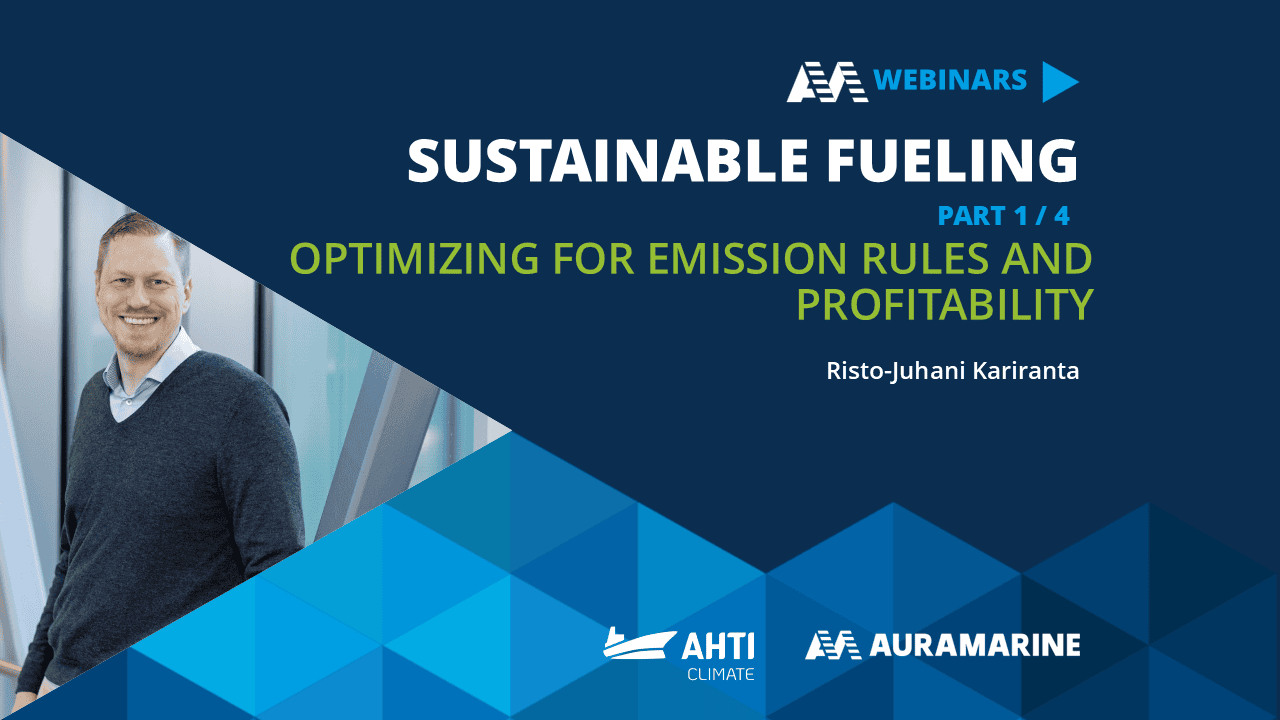
Risto-Juhani Kariranta is the CEO and founder of Ahti Climate. Ahti Climate focuses on FuelEU Maritime pooling and improved EBIT through emission compliance optimization.
Before Ahti Consulting, Kariranta has worked more than 20 years in marine sector and focusing on shipping performance improvements, shipping IT and decarbonisation.
Would you like to hear more? Join our Auramarine webinars 2026.
This article based on Auramarine webinar series 2026 first session Optimizing emission rules and profitability. Secure your place to our next webinars about methanol, ammonia and biofuels on the beneath.
AURAMARINE WEBINARS 2026
How to ensure compliance, safe and sustainable fueling with methanol, ammonia and biofuels? Gain actionable insights on methanol, ammonia, and biofuels and ensure your operations remain compliant and efficient.
AURAMARINE WEBINARS 2026 - OMPTIMISE EMISSION RULES AND PROFITABILITY
In this webinar we dived into evolving EU and IMO compliance requirements, emissions reporting, and adopting practical strategies for operational optimization. Fill in the form to receive a link to webinar recording.